
Book Appointment Now

AI-Generated Visuals Are a Legal Liability — And C2PA Is What Changes That
AI-generated visuals legal liability is no longer a theoretical risk. Every week, another brand makes headlines for the wrong reason — an image that cannot be traced, a product visual that turns out to be synthetic, a campaign asset with no verifiable origin.
The legal and reputational consequences are real. Platforms are tightening their content authenticity policies. Regulators across the EU and US are advancing frameworks that require disclosure of AI-generated content. Furthermore, audiences are becoming increasingly skeptical of visual content they cannot verify.
The question is no longer whether your brand needs a content provenance strategy. The question is whether you already have one.
What Is C2PA — And Why Does It Matter for Brand Visuals?
C2PA stands for Coalition for Content Provenance and Authenticity — an open technical standard developed by Adobe, Microsoft, Google, and the BBC through the Content Authenticity Initiative.
At its core, C2PA is a cryptographically secured record embedded directly inside a visual asset. Unlike a watermark or a metadata tag that someone can strip or edit, a C2PA content credential travels with the file — surviving platform uploads, format conversions, and distribution at scale.
When someone examines a C2PA-credentialed image, they can verify five things:
- Who created it
- When the creator produced it
- What tools the creator used in production
- Whether AI was involved — and to what extent
- Whether anyone modified the asset since credentialing
This is not a compliance checkbox. Instead, this is infrastructure for operating in an era where the origin of every visual asset will be interrogated.
The Four Risk Categories Behind AI-Generated Visuals Legal Liability
Brands using AI-generated visuals without content provenance documentation face four distinct categories of risk. Understanding each one separately matters — because each requires a different internal response.
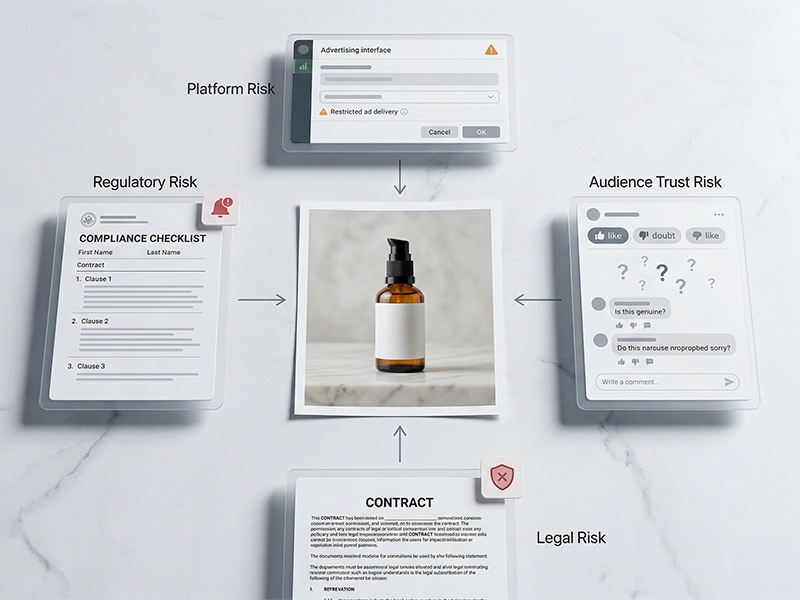
Platform Risk Major platforms including Meta, Google, and YouTube are actively developing and enforcing content authenticity policies. Assets without verifiable provenance increasingly get flagged, restricted, or deprioritized in distribution. Consequently, brands that built their visual libraries on unverified AI imagery face operational disruption as enforcement intensifies.
Regulatory Risk The EU AI Act and emerging US state-level regulations are establishing disclosure requirements for AI-generated content in commercial contexts. Moreover, operating without provenance documentation creates compliance exposure that grows more significant over time — not less. Brands selling across jurisdictions are already inside the regulatory perimeter.
Reputational Risk A brand that cannot verify the origin of its own visual assets cannot defend itself when questioned. In an era of growing public skepticism around synthetic media, unverified content is a liability — regardless of its aesthetic quality. The inability to answer “where did this come from” is itself a story.
Legal Risk Copyright ownership of AI-generated imagery remains legally complex and contested in most jurisdictions. C2PA credentials do not resolve copyright questions directly. However, they establish a documented record of creation that becomes essential in any dispute. Without that record, the brand’s legal position is entirely reactive.
How C2PA Content Credentials Address AI-Generated Visuals Legal Liability
Embedding C2PA credentials into a visual asset involves three stages. Each stage builds the documented record that transforms an unverified asset into a defensible one.
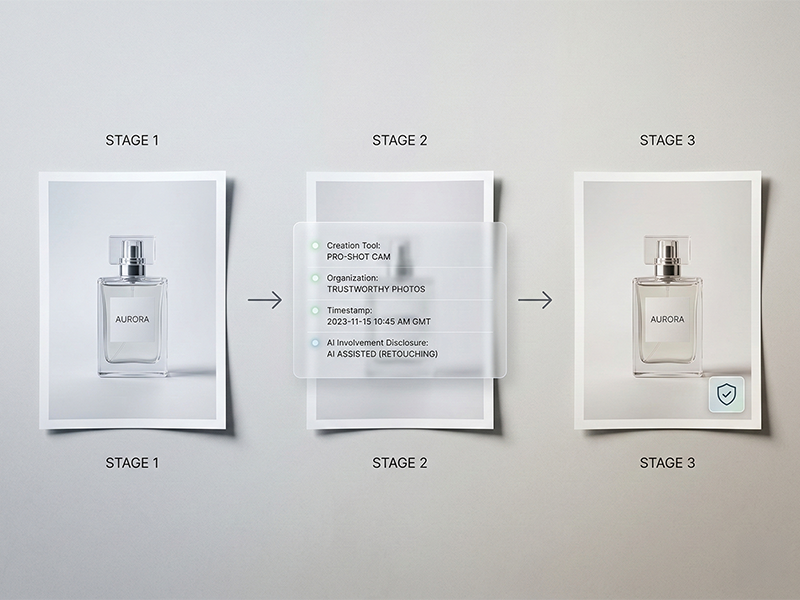
Stage 1 — Asset Assessment Existing visual libraries get audited against C2PA standards — identifying which assets have provenance gaps and which are ready for credentialing. This stage typically reveals how significant the unverified AI visuals legal liability already is before any remediation begins.
Stage 2 — Credential Configuration The asset moves through a C2PA-compatible workflow — documenting origin, authorship, creation method, and any AI involvement. The workflow cryptographically secures this information and embeds it into the file itself. Therefore, the record cannot be separated from the asset, stripped during upload, or disputed after the fact.
Stage 3 — Verification Anyone can verify the credentialed asset using tools like Adobe’s Content Authenticity verify tool or the CAI’s official verification platform at verify.contentauthenticity.org — no special software required. This open verifiability is what makes C2PA useful as a legal and regulatory instrument, not just an internal process.
Who Needs C2PA Credentialing Now
C2PA content credentials are not exclusively for large enterprises or regulated industries. Any brand that uses AI-generated visuals in commercial contexts — product photography, advertising creative, campaign imagery, editorial content — carries a provenance liability that C2PA directly addresses.
Additionally, the window for proactive implementation is narrowing. Brands that implement content credentialing now position themselves ahead of the regulatory curve. Brands that wait will find themselves retrofitting an entire visual asset library under deadline pressure — addressing AI-generated visuals legal liability reactively rather than strategically.
The difference between those two positions is not just operational. It is financial, reputational, and in some jurisdictions, legal.
The Era of Unverified Visual Content Is Ending
Platform policies, regulatory frameworks, and audience expectations are converging on the same conclusion: origin matters.
C2PA content credentials are the technical infrastructure that makes verified visual production possible. Implementing them is not a competitive advantage. It is the baseline requirement for any brand that intends to operate with integrity in the next era of digital media — where every AI-generated visual either has a documented origin or has a problem.
Virtanica integrates C2PA content credentials into AI creative workflows for international brands across US, UK, and European markets. See how it works →